
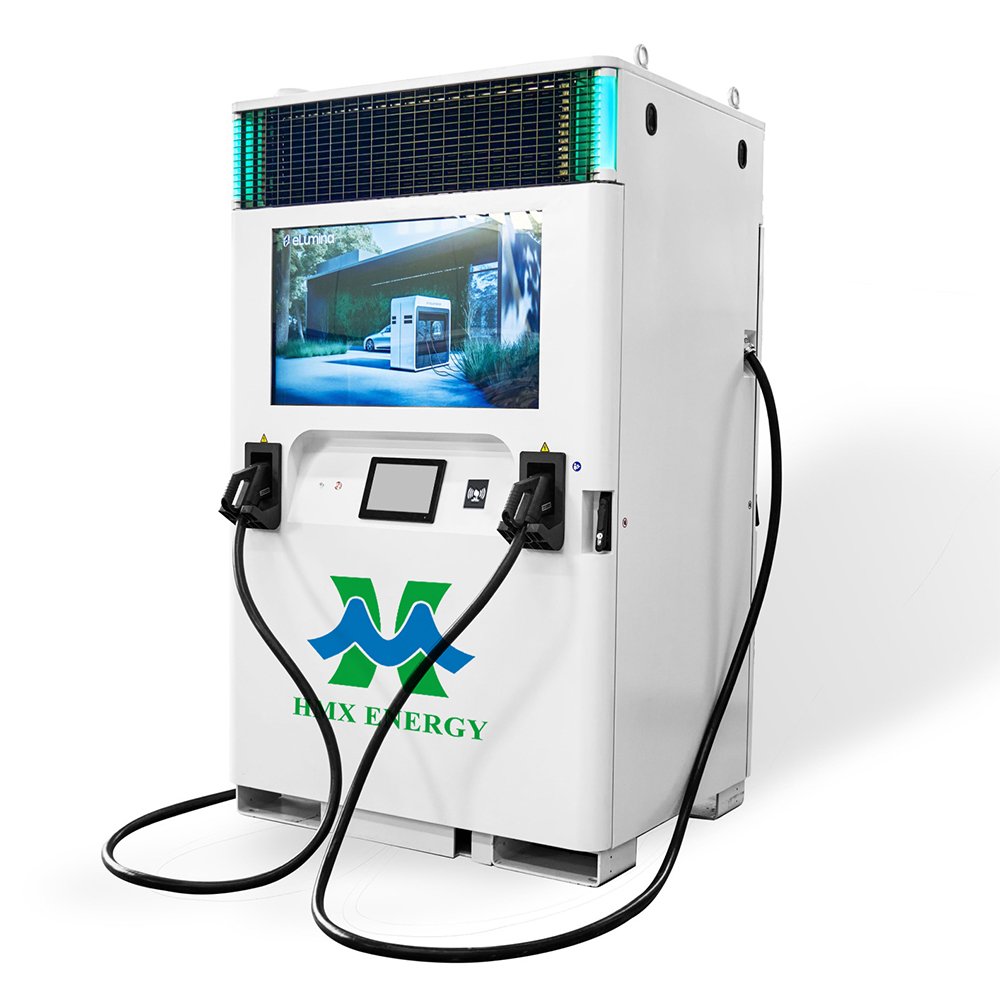
An EV charging BESS must support the next charging peak, not just the first one. The decisive sizing question is often whether the battery can recover enough energy between busy periods while respecting the site’s grid limit and continuing to serve vehicles. A large cabinet can still be the wrong solution when its recharge opportunity is too small.
For a charging developer, EPC or fleet-depot owner, that distinction affects queue length, promised service, connection planning and investment. A proposal that starts every simulated day with a full battery can conceal a deficit that accumulates during normal operation. Buyers need a chronological model with a credible starting condition and a complete account of where replenishment comes from.
This guide focuses on that recharge-window problem. When comparing HMX EV charging equipment, use it to define the evidence requested from the system designer. It does not replace a site-specific electrical design, utility agreement or local approval, and it does not claim measured performance for a proposed installation.
The bottleneck can move during the same operating day
During a busy period, the constraint may be discharge power: chargers request more power than the grid and available generation can supply. Between busy periods, the constraint may become charging power or time. Later, a depleted battery can make usable energy the limiting factor even though the converter has adequate power.
These are different failures and require different remedies. More battery energy might extend a busy period, but it cannot create an electrical supply that does not exist. A larger converter might shorten recovery only when the grid, battery and installation permit that charging power. Moving sessions can help a depot with flexible departures but may be unacceptable at a public site.
Write the service objective first. Specify which vehicles must receive which service, the acceptable scheduling flexibility and the operational response if demand exceeds the agreed case. Separate this from a tariff objective. Keeping an import peak below a billing target is not the same commitment as maintaining charging service through a constrained connection.
Do not treat storage as a permanent substitute for sufficient incoming energy. It can shift energy in time, subject to losses and limits. If the required charging service repeatedly consumes more energy than the permitted sources replenish, the design needs a changed service, supply or generation arrangement. Additional capacity can postpone that shortfall without resolving it.
Start with the power the site may actually import
The grid input is not simply the transformer nameplate or the charger’s rated output. Establish the agreed connection limit, electrical constraints, other site demand and any controller-imposed operating target. A shopping centre, industrial depot or roadside facility may have loads that compete with battery charging when no EV is connected.
تُعد DOE AFDC guidance on EV readiness recommends utility involvement and site-level assessment of power availability and required upgrades. Its U.S. planning context should not be mistaken for another country’s rules. The transferable purchasing lesson is to verify available supply before treating a storage quote as a complete site solution.
Obtain interval records for the relevant non-EV loads where possible. Align their timestamps with the charging model and identify whether the records include existing chargers or storage. Otherwise, the model can count an existing charging load twice or mistake a historical battery recharge event for a building load.
Keep physical and commercial limits distinct. The approved electrical design may allow an import level that the owner prefers not to reach because of the tariff. A temporary utility restriction may also differ from the long-term connection agreement. Document which limit applies to each modelled period and who can authorize its change.
Draw the measurement boundaries before opening the spreadsheet
Identify the grid connection, shared AC bus, battery DC boundary and vehicle delivery boundary. A charger output rating describes delivery capability, not necessarily its AC input or the energy stored inside the vehicle. A battery energy rating likewise does not directly state how much energy can reach an EV after conversion and auxiliary consumption.
بالنسبة لنظام integrated storage charging unit, ask for an energy-path diagram and the proposed configuration’s matching datasheet. The current HMX listing describes a maximum output of 180 kW and energy options labelled 100 kWh and 200 kWh, while its larger-version note specifies 193 kWh. Resolve the exact supplied rating and usable boundary in writing; the family label alone is not an acceptance value.
Integration can simplify packaging without removing the need to distinguish limits. Confirm whether the stated charging power is a shared total or a per-connector capability, under which battery and supply conditions it applies, and what happens when connected vehicles request different power levels. Optional connector types do not prove compatibility with a particular local fleet.
| HMX listing | Published input | Required clarification for the recharge model |
|---|---|---|
| Integrated storage charging unit | Maximum output 180 kW | Shared output allocation, sustained conditions and source constraints |
| Integrated unit energy options | 100 kWh / 200 kWh; larger-version note 193 kWh | Exact ordered configuration, rated energy and usable energy boundary |
| Liquid-cooled storage cabinet | Rated power 125 kW; rated energy 261.04 kWh | Matched electrical specification and independently stated charge/discharge limits |
| Liquid-cooled cabinet battery chemistry | LFP | Approved operating conditions, protection limits and model-specific performance evidence |
Build a chronological session profile, not a daily average
Represent sessions by arrival, connection, requested service and departure constraints. Use measured site records where available, identifying the collection period and any missing sessions. At a new site, label assumptions explicitly and test their sensitivity. A forecast does not become an observed charging profile because it has been placed in a detailed spreadsheet.
A vehicle’s charging power can change during a session. Do not assign the charger’s maximum output throughout unless the proposed service and vehicle evidence support that profile. Keep the vehicle-delivery request separate from the AC demand calculated through the actual equipment model.
Include overlapping sessions. A daily total can look manageable while several arrivals create a discharge-power shortfall. Conversely, adding every connector rating together may exaggerate demand if the agreed operating policy limits concurrent charging. Show both the requested service and the control policy instead of silently replacing one with the other.
Choose a time resolution that preserves the events material to the decision. Coarse averaging can hide brief power constraints or shift the apparent recovery window. Increasing resolution does not repair missing or unreliable input data. Report why the selected interval is adequate and how the result changes when consequential events are represented more precisely.
Calculate recharge headroom after continuing site demand
At a shared AC boundary, a preliminary headroom expression is permitted grid import plus generation available at that boundary, minus concurrent non-battery loads. Positive headroom is only a possible source for battery charging. It must still pass the converter, battery, electrical and control constraints. Negative headroom indicates a deficit before storage support or load management.
Use consistent signs and units. Calculate energy by accumulating power over elapsed time, with the declared conversion between the AC and battery boundaries. Charge and discharge losses need separate treatment in a detailed model. Do not apply a round-trip figure twice or treat it as a universal constant at every operating point.
تُعد قد يبدو الاحتياطي المنخفض جذابًا بعد يوم مشمس ويصبح غير مناسب بعد طقس سيئ أو حمل مسائي مرتفع. راجع متى يمكن الشحن وما القيود المطبقة. وإذا كان الشحن من الشبكة مقيدًا، فلا يمكن لتغيير الإعداد أن يخلق فرصة إعادة شحن لا يمتلكها التركيب. distinguishes charge-source permissions, power targets and SOC constraints. It also notes that a target may be unattainable when energy is unavailable. Use these concepts to review a model, not to assume a quoted EMS implements SAM’s algorithms or its default settings.
For each interval, constrain charging by the available source, permitted charging power and remaining room in the approved battery operating window. Constrain discharge by the service deficit, deliverable power and available energy above the required reserve. These are proposed modelling checks, not new rated values for an HMX product.
Retain the source of each constraint. A BMS permission, a converter limit and a site import cap can produce the same reduced charge rate while requiring different remedies. An unexplained clipped power trace is insufficient evidence for choosing a larger battery.
Carry the battery state through the entire sequence
Check the model’s treatment of the upper and lower endpoints. A simple spreadsheet can accidentally accept energy above the usable ceiling or continue discharge below the agreed reserve. Log rejected energy and unmet demand explicitly. Otherwise, the reported balance may appear complete while the calculation has borrowed energy from outside the permitted operating window.
Also distinguish an energy-state model from the equipment’s SOC estimator. A modelled energy value and a displayed percentage are not interchangeable acceptance measurements. Ask how the supplied controller determines readiness and how its estimate is checked against the available operating records. The commissioning plan should reconcile those quantities sufficiently for the promised service, without demanding that a display itself prove measured usable capacity.
Update the available energy from the previous interval, using the declared energy admitted, energy removed and any explicitly modelled losses. Preserve the result into the next busy period. Do not reset the battery to full when the clock crosses midnight, when a chart changes page or when a representative day is repeated.
The initial condition must have a physical explanation. Commissioning might begin with a fully charged battery, but routine operation should begin from a state produced by the preceding duty or an agreed preparation procedure. Test whether the repeated sequence remains feasible without an artificial refill.
Compare the ending state with the starting state over repeated service cycles. A declining trend exposes replenishment that is insufficient for that sequence. A similar starting and ending state is useful but not a complete pass: a power limit or reserve violation inside the period can still have interrupted service.
Track unavailable service as a separate output. If the model reduces charger power to preserve SOC, record delayed or curtailed delivery and its effect on departure requirements. An attractive energy balance obtained by quietly failing the customer’s service objective is not a successful storage design.
| المخرجات | السؤال الذي تجيب عليه | What a favourable value cannot prove |
|---|---|---|
| Connection-point power trace | Was the applicable import target respected? | That every vehicle received its required service |
| Battery energy trajectory | Did recovery replenish successive service periods? | That converter power was sufficient throughout |
| Charge/discharge limit events | Which restriction changed actual power? | That adding nominal capacity resolves the cause |
| Vehicle delivery and departure outcomes | Was the contracted service completed on time? | That the tariff objective was met |
| Source and loss accounting | Can the energy balance be reconciled? | That assumed efficiencies are measured site results |
| Repeated-cycle ending condition | Does the duty depend on an artificial reset? | That untested weather or demand cases are covered |
Do not let solar generation become an undocumented refill
Use generation at the relevant boundary and time, not annual production divided into convenient daily blocks. PV output may coincide with charging demand rather than with the recovery opportunity. Energy already used by the building or delivered directly to vehicles is not also available to recharge the battery.
Identify whether the architecture is AC-coupled, DC-coupled or otherwise integrated, and apply the appropriate conversion path. A claim about recovering curtailed or clipped generation requires evidence that the proposed hardware, connection arrangement and controls can actually use that energy. A generic solar diagram does not establish it.
Test a relevant low-generation sequence without inventing a universal weather allowance. Use documented local data or clearly labelled design scenarios. Where the service relies on solar, report what the operator does if the expected recharge does not occur. Storage autonomy and replenishment reliability are related but different design questions.
Evaluate aging and temperature at the service boundary
التيار 125 kW, 261.04 kWh cabinet listing provides a starting point for equipment discussion, not a promise of identical usable energy and power throughout the project life. Request the matched supplied specification, operating envelope and evidence for the planned duty.
Ask the supplier how the model changes with approved battery condition and ambient conditions. Do not insert a fixed degradation percentage or a temperature derating curve merely because another product uses it. Missing performance inputs should be recorded as open design risks.
Include auxiliary demand at its actual supply boundary. Cooling, controls and standby loads can matter during recovery, especially when charging headroom is already scarce. Keep any assumed consumption visible and replace it with configuration-specific data before commercial acceptance.
Apply the agreed reserve consistently. If backup service is part of the project, determine when that reserve is protected and when it may be used. The same stored energy cannot be fully committed to charging peaks and fully retained for backup at the same moment.
Separate a technically feasible model from a profitable one
Compare forecast-based dispatch with a less favourable but documented arrival sequence. If a controller knows every future session in the calculation but does not have that information on site, label the result as an optimistic scheduling case. Ask for the actual forecast inputs, update process and fallback policy. A service commitment should not depend on information the operating controller cannot obtain.
Distinguish controllable and non-controllable demand. A depot might reschedule selected vehicles with the fleet manager’s agreement; a public operator might only reduce power within its disclosed service policy. Do not assume all customers accept delay. Retain separate results for the original requested service and any revised managed-charging arrangement so commercial approval is informed.
Run the physical service check before presenting savings. A tariff optimizer might deliberately delay recharge because electricity is expensive, leaving insufficient energy for the next vehicle peak. Decide whether service readiness or cost minimization has priority when those objectives conflict.
تُعد SAM electricity-rate documentation distinguishes energy and billing-demand calculations and notes modelling limitations. Check the actual local tariff, including its measurement and billing rules. A software default or another market’s rate cannot support this site’s savings claim.
Use the same delivered-service basis when comparing alternatives. A storage proposal that serves fewer vehicles should not be presented as cheaper operation without disclosing that difference. Include relevant installed and ongoing costs using current project quotations; leave payback unresolved when those inputs are unavailable.
A useful comparison may include a grid upgrade, managed charging, a changed operating schedule and a storage solution. Do not assume storage is always the lowest-cost choice. The buyer needs the feasible alternatives and their evidence, not a calculation designed to make one architecture win.
Turn the model into witnessed acceptance cases
تُعد AFDC charging procurement and installation checklist includes utility coordination, metering, operating responsibilities and ongoing costs. For a storage-assisted project, extend that planning file with recharge-specific evidence. The checklist is a planning resource, not a certificate that a particular installation complies with local requirements.
Retain a configuration-controlled handover package. It should identify the final import target, charge-source permissions, reserve policy, charger allocation and software revisions. Include the approved means of changing those settings and the roles authorized to do so. Without that record, a later operating change can invalidate both the witnessed acceptance result and the model used to select the equipment.
After handover, compare observed recovery with the accepted case when service demand changes. More connectors, longer opening hours or a new building load may alter recharge headroom even if the battery remains healthy. Review the duty before blaming the cabinet for a shortfall created by a different site schedule.

Agree how the commissioned system will demonstrate source limits, recovery and repeated service. Use an approved test plan with safe loading or simulation arrangements where actual vehicle sessions cannot reproduce the required case. Identify which conclusions come from field observations and which still depend on a validated model.
Record the connection-point meter, charger delivery, battery state, charge permissions and control commands on an aligned timeline. Preserve the first limiting event when a case fails. Retesting after a configuration change should identify the new version rather than overwrite the original result.
تُعد storage-integrated charging specification guide covers the wider equipment interfaces. For recharge-window acceptance, add the exact starting condition, continuing site load, source availability, recovery endpoint and next-service requirement. Those details make the model’s central claim testable.
| الحالة | الأدلة المطلوبة | Decision if the case fails |
|---|---|---|
| Busy period within approved duty | Grid, battery and vehicle-delivery traces | Identify power, energy or service-control constraint |
| Recovery with continuing site loads | Actual charging headroom and energy restored | Review supply, charge limits or operating schedule |
| Next busy period without manual SOC reset | Inherited starting state and completed service | Reject reliance on an undocumented refill |
| Restricted generation or forecast error | Approved scenario and recorded fallback response | Revise the service commitment or recovery plan |
| Metering or communications interruption | Safe fallback, event record and restoration sequence | Correct the controls before accepting the affected function |
The procurement decision should name the binding constraint
Require the designer to identify what sets the final size: peak discharge power, usable energy, recharge power, source energy, reserve or departure service. Ask how much the result changes when the uncertain inputs change. This is more informative than a single unexplained cabinet count.
For proposals using commercial and industrial storage equipment, retain the model, input provenance, matched equipment documents and acceptance criteria as part of the procurement file. Hardware selection should follow a defensible service calculation, not replace it.
A sound recommendation states what the equipment can support under the agreed conditions, what it cannot support and which operating action is required when conditions change. If the next peak depends on recharge that the site cannot deliver, address that constraint before ordering more nominal energy. The strongest charging-storage design is the one that can repeat its promised service.