
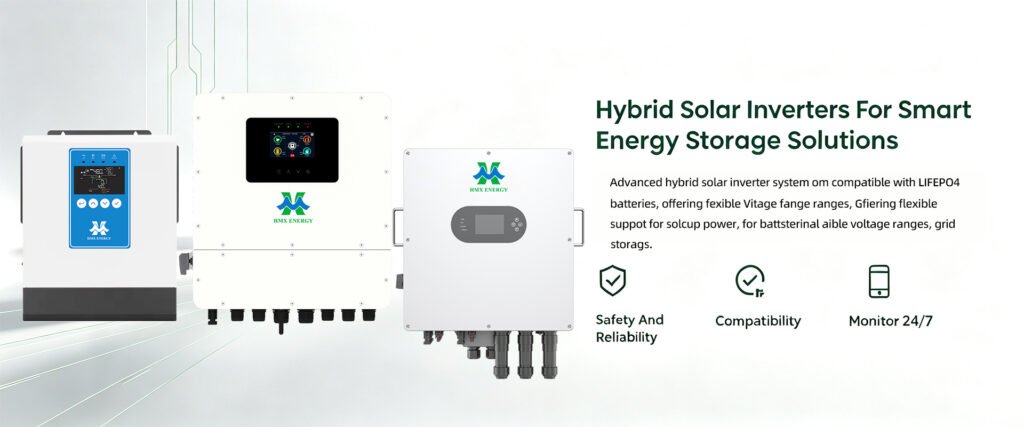
A hybrid inverter can keep the lights on during an outage while leaving an important acceptance question unanswered: does the installation’s fault protection work correctly when the utility is no longer the source? A successful backup demonstration proves power delivery. It does not, by itself, prove the earthing arrangement, neutral switching or protective-device coordination.
For an EPC or distributor, the practical answer is to approve these details before site acceptance testing, or SAT. Obtain the exact inverter manual, the transfer equipment drawing and a mode-by-mode protection review from the qualified electrical designer. Do not add a neutral-to-earth connection because a diagram for a different brand shows one. This article is a procurement and verification guide, not a wiring instruction.
Start with the installation, not the word “hybrid”
The sales description does not establish whether a backup output has a switched neutral, a permanently connected neutral, an internal grounding relay or an external transfer requirement. Nor does an enclosure protection rating answer those questions. When comparing solar inverter options, request the installation documentation for the particular model, region and firmware configuration being supplied.
The designer needs to identify the incoming supply’s earthing arrangement, the backed-up distribution board, all alternative sources and every normal or maintenance bypass path. An existing building may contain shared neutrals or alterations that are absent from an old single-line drawing. Treat the drawing as something to verify against the actual installation, not as proof that the installation is correct.
Separate protective earthing from the circuit’s neutral arrangement. A transfer operation must not be assumed to preserve the required protective function merely because the enclosure remains connected to an earth conductor. The designer must establish the relevant fault-current paths and disconnection provisions in each permitted operating state under the applicable local rules.
A manufacturer’s grounding relay is an example, not a universal design
Victron’s Wiring Unlimited grounding discussion describes how certain Victron inverter/chargers change an internal neutral-to-chassis connection with their operating state. The useful lesson for a buyer is that this function can be state-dependent. It is not evidence that an HMX inverter contains the same relay or requires the same external connection.
A second manufacturer reference makes the model boundary explicit: the Inverter RS Smart Solar installation manual describes its own grounding relay and permitted residual-current device arrangement. Those instructions belong to that equipment. Copying its device type or terminal connections into another manufacturer’s installation would skip the compatibility and local-code review.
A useful request to the supplier is therefore narrower than “does it support backup?” Ask for the neutral and grounding schematic in each approved mode, the transfer-device interface requirements, the permitted protective devices, and the limitations of the proposed parallel configuration. Require a written clarification if the manual and the project drawing appear inconsistent.
| Stato operativo | Question for the designer | Evidenza da conservare |
|---|---|---|
| Utility supplying the backup board | Which neutral path and source reference apply? | Supply arrangement and transfer contact diagram |
| Inverter supplying an intentional island | What establishes the designed reference and fault protection? | Model-specific internal schematic and protection assessment |
| Generator supplying or assisting the system | Does generator neutral treatment change the arrangement? | Generator and transfer drawings reviewed together |
| Maintenance bypass in service | Which circuits remain energised and protected? | Bypass schematic, labels and approved operating procedure |
| Return from island to utility | Are switching and protection valid during the transition? | Approved sequence and witnessed functional records |
Give the backup board its own protection review
Inverter-fed fault conditions may differ from utility-fed conditions. The designer should obtain the manufacturer’s available fault-current behaviour, including its duration and relevant control limits, rather than assume a conventional upstream breaker will perform identically in both modes. Protection selection must consider the actual circuit and source, not only the inverter’s continuous power rating.
Schneider Electric’s UPS earthing-arrangement guide discusses checking arrangements across operating configurations. A hybrid inverter is not automatically a UPS, but the mode-by-mode review principle is useful. The project-specific designer remains responsible for deciding which requirements and protective measures apply.
The battery belongs in this review too, but on its own terms. Adding a larger home battery storage bank can extend the intended backup duty; it does not prove that an AC fault will disconnect correctly. Keep energy availability, inverter fault response and installation protection as separate acceptance topics.
Define what the acceptance record must demonstrate
An RCD test button is not a substitute for verification of the complete installation. Specify the inspection and instrumented tests required by the local rules and approved design, carried out by competent personnel using suitable equipment. Record the operating state, circuit, instrument identification and actual result. A photograph of a green status lamp is not enough.
The owner should also know what a failed result means. Unexplained tripping should not be “fixed” by disabling protection or changing bonding arrangements without an approved redesign. Likewise, a fault that appears only in island mode must not be dismissed because the same load works from the grid.
| Review item | Record expected | Reason to withhold acceptance |
|---|---|---|
| As-built configuration | Exact inverter, transfer device and distribution revision | Installed equipment differs from the approved design |
| Protection verification | Designer-required inspection and measured test results by mode | Only a backup load demonstration is available |
| Configuration control | Approved settings export and access responsibilities | Safety-relevant options were changed without review |
| Maintenance operation | Identified isolation points and authorised bypass procedure | Staff cannot determine which sources remain live |
| Customer handover | Mode limitations, labels and escalation instructions | The owner is told all circuits behave identically in every mode |
Make this a purchase-order hold point
Ask the supplier to provide the model documentation before equipment approval, the installer to submit the final drawings before energisation, and the responsible designer to approve the protection arrangement before handover. Allocate the cost of resolving discrepancies in the contract. This prevents an unresolved design issue from becoming an argument after delivery.
For an integrated project, use the checklist di approvvigionamento commerciale per BESS to place the earthing review beside the wider controls, protection and acceptance obligations. Neither a product certificate nor a successful factory test replaces the site installation review.
The acceptance decision should be straightforward: the delivered hardware, approved drawings, settings and measured evidence must describe the same system. If they do not, retain the hold point. Reliable backup includes a defensible protection arrangement, not just uninterrupted lights.