
The utility has returned, the battery is supplying the building, and the operator wants normal service restored. That is not enough information to authorise a breaker to close. BESS grid reconnection requires a defined sequence: establish permission, verify the relevant electrical conditions, execute the approved transfer, confirm the resulting state and then restore dispatch.
The sequence differs between a live microgrid that resynchronises with the utility and an open-transition arrangement that interrupts the backed-up supply before transferring. Specify which architecture you are purchasing. “Automatic return” says little about the interruption, protection logic or behaviour when a required signal is unavailable.
Write the return sequence alongside the outage sequence
Our 储能系统黑启动与备用指南 addresses establishing an island supply. Returning to the utility is a separate operating obligation. A project can demonstrate successful island operation and still lack an approved, testable return sequence.
Start with the interconnection agreement and the responsible network operator’s current requirements. Record which party grants permission, whether permission is automatic or explicit, which protection functions must be healthy, and which settings require approval. Keep these requirements tied to the site and the installed equipment revision.
The US Department of Energy’s distributed-energy interconnection checklist, published in 2021, organises the utility coordination process. It is a useful project-management reference, not a source of universal settings for a project in Malaysia, Kenya or another jurisdiction. Obtain the actual conditions from the authority governing your connection.
Separate grid qualification from synchronisation
Grid qualification asks whether the utility supply meets the approved conditions for return. Synchronisation, where the design reconnects a live island, asks whether the two systems satisfy the approved conditions for closing the interconnection. Neither condition should be inferred from a dashboard icon labelled “grid available.”
The 2021 NLR guide to interconnection rules and IEEE 1547 describes the role of authorities in adopting technical requirements. Referencing a standard in a tender does not remove local approval or establish that the same edition and settings apply everywhere. Ask the integrator to identify the adopted rules and the project-approved configuration.
For a closed-transition design, require the engineering team to document the relevant voltage, frequency, phase and switching conditions, together with the protective interlocks. For an open-transition design, require the interruption and load-restart sequence instead. Do not label an open transition “seamless” unless the delivered system has evidence supporting that claim for the loads concerned.
| 状态 | Entry condition to document | Action if the condition is not met |
|---|---|---|
| Island remains in service | Island supply healthy and permitted to continue | Apply the approved load or shutdown policy |
| Utility qualification | Approved utility measurements and permission available | Remain disconnected; identify the blocking reason |
| Transfer preparation | Switching architecture and required interlocks ready | Cancel the transfer request without defeating protection |
| Reconnection or transfer | Approved synchronisation or open-transition conditions met | Record unsuccessful operation and follow the recovery sequence |
| Connected confirmation | Actual device feedback and supply state verified | Block normal dispatch pending state confirmation |
| Dispatch restoration | Owner’s import, export and charging policy enabled | Maintain the defined restricted operating state |
One controller must own the transfer request

A battery PCS, generator controller, automatic transfer system and EMS may all know that the grid has returned. They should not all act independently on that information. Identify the device that owns the transfer request and the devices that provide permission, measurements and final interlocks. Define how commands are acknowledged and how actual position feedback is distinguished from the last commanded position.
NLR’s microgrid controls research includes evaluating controls with software and hardware-in-the-loop platforms. For procurement, that supports asking for sequence-level evidence rather than accepting an isolated component demonstration. It does not prove that a particular commercial controller has passed those evaluations.
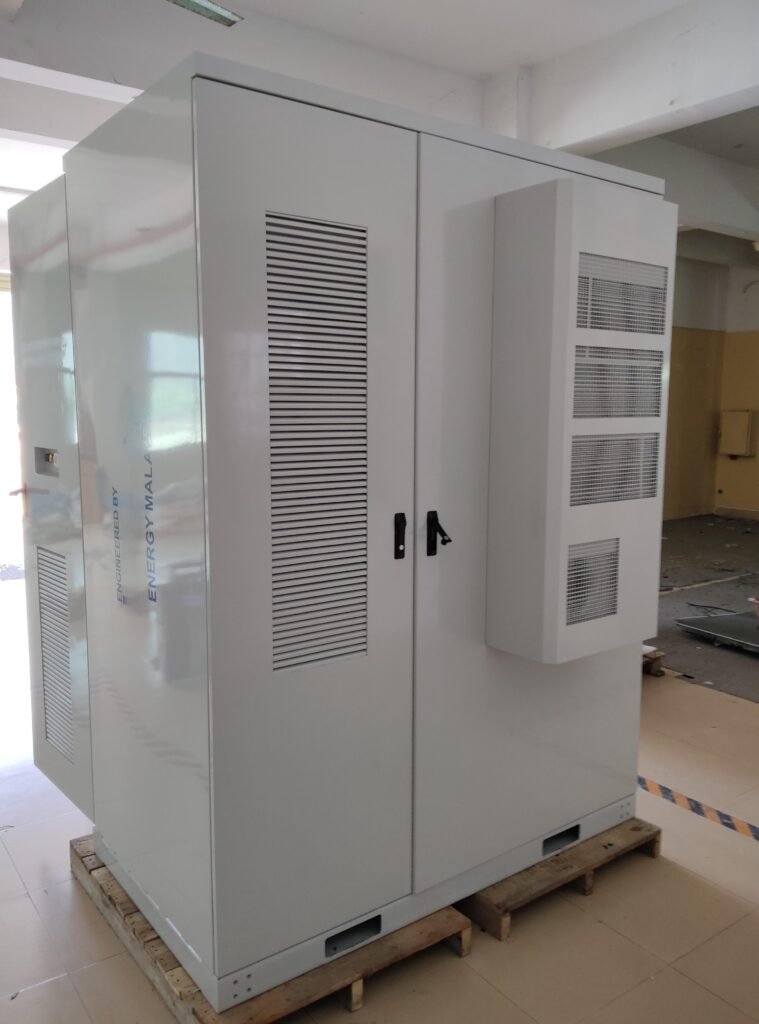
When reviewing an industrial energy storage proposal, make the return sequence a named integration deliverable. A cabinet quotation alone may not include the transfer switchgear, utility interface or site controls. Put those responsibilities in the scope instead of discovering the omission during commissioning.
Test the blocked return, not only the successful one
The most informative acceptance scenario may be a utility return that should not cause reconnection. Examples include missing permission, invalid measurements, an unhealthy protection function, contradictory switch feedback or an operator lockout. Test these conditions using the approved commissioning method, with responsible personnel and the authority’s required involvement. Do not create uncontrolled live faults to demonstrate an interlock.
Request an event trace that links the source measurements, qualification decision, command, feedback and resulting power flow. The time resolution must be suitable for the function being assessed. A slow cloud trend may show that grid power resumed, yet miss the transfer event itself. Avoid claiming a transfer duration from a recording that cannot resolve it.
| Acceptance scenario | 要求的证据 | Buyer concern addressed |
|---|---|---|
| Normal approved return | Sequence trace and load response under the agreed test conditions | Production loads resume as specified |
| Return permission absent | Blocked command and an intelligible operator message | The controller respects the connection authority |
| Transfer unsuccessful | Device feedback, alarm and approved recovery behaviour | No repeated uncontrolled closing attempts |
| Utility deteriorates during return | Aborted or completed sequence according to the approved design | Transition logic handles changing conditions |
| Communications unavailable | Documented local fallback and restricted actions | A network failure does not invent permission |
Do not let recharging create the next problem
After return, the battery may need energy and the building may be restarting equipment. Unrestricted recharge can compete with returning loads for transformer or import headroom. Write a restoration policy that prioritises the owner’s actual requirements: load recovery, backup reserve, demand control and any export restriction. It should be part of acceptance, not a later optimisation experiment.
Separate those supervisory decisions from the protections described in our BMS、PCS 与 EMS 责任指南. A tariff-driven EMS request must not override a battery limit or a required interconnection interlock.
Before signing off, ask the integrator to demonstrate both a permitted return and a correctly blocked return. The resulting record should explain why the system reconnected, which conditions allowed it, what happened to the loads and how normal dispatch resumed. That is a more useful deliverable than an unexplained “grid restored” message.