
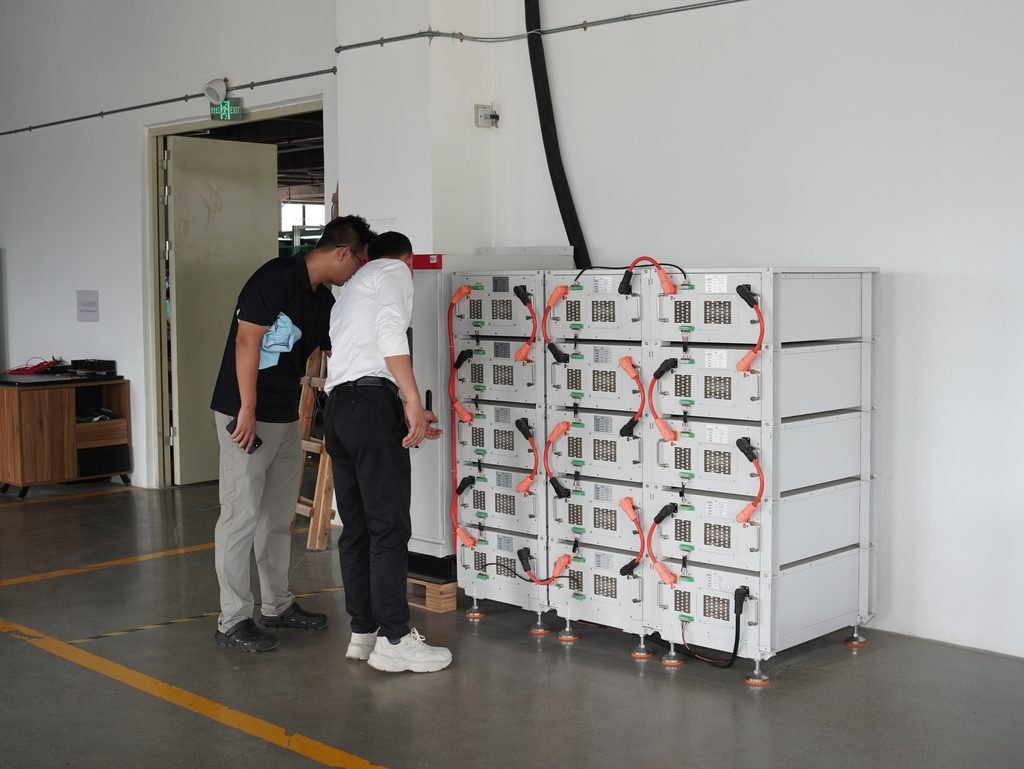
A battery cabinet can complete a charge and discharge demonstration while still carrying an interface error that stops the project after delivery. The buyer sees power on a screen; the underlying question is whether the protective limits, alarms, communications and recovery states behave as the approved design requires.
A BESS factory acceptance test, or FAT, should therefore be a contractual decision about a named equipment configuration. For overseas EPCs, it is also the last convenient opportunity to resolve factory wiring, firmware and document issues before freight, customs and site mobilisation make corrections harder.
The early evidence requirements belong in the RFQ. HMX’s commercial BESS procurement checklist describes the upstream document gates; this article develops the test and shipment-release portion.
Buyer decision: approve shipment only when the tested configuration matches the order, the agreed functional cases have recorded outcomes, and every unresolved item has an explicit release decision. A video of normal operation cannot replace those records.
Freeze the test object before arranging the witness
Start with an equipment schedule: battery model, rack arrangement, BMS revision, PCS model and software, EMS version, cooling equipment and protective devices. Add the drawings and parameter files that define the build. Test evidence must point to this baseline rather than to a product family with a similar name.
The DOE FEMP lithium-ion storage specification template, published in August 2025, provides a procurement starting point that agencies are encouraged to customise. Use it as a reference for drafting measurable project requirements, not as proof that an individual supplier has met them.
Clarify which interfaces can be tested physically and which require a simulator. A factory without the site transformer, generator, revenue meter or utility connection cannot reproduce every installation condition. Record the simulation boundary, the assumptions it introduces and the corresponding test that must be repeated at site acceptance.
| Data field | Required evidence | Reason for a hold |
|---|---|---|
| Equipment identity | Model, serial number and approved bill of materials | Shipped hardware differs from the reviewed build |
| Software baseline | BMS, PCS and EMS versions plus settings export | Witness cannot reconstruct the tested configuration |
| Measurement chain | Instrument identity, calibration status and connection diagram | Claimed output has no auditable measurement basis |
| Test boundary | Actual devices, simulated inputs and unavailable site equipment | Factory simulation is presented as site approval |
| Acceptance limits | Contract values, conditions and pass/fail rules | Supplier chooses limits after seeing the result |
Test the command path and the protection path separately

The EMS may request discharge while the BMS reduces the permitted current. A successful test shows the PCS respecting the battery limit and the supervisory system recording the reason. Merely changing a display value does not establish the full response.
Assign one owner to each command, measurement and alarm. The distinction between layers is developed in the BMS, PCS and EMS interface guide. The FAT protocol should turn that ownership into a traceable observation: command sent, limit received, power measured and event recorded on a common time base.
Use manufacturer-approved simulation and injection methods under a competent test team. Do not create real thermal runaway, hazardous overvoltage or an uncontrolled short circuit to demonstrate a software alarm. Destructive certification tests and contractual functional checks answer different questions and require different facilities.
| Case | Observation to capture | Acceptance question |
|---|---|---|
| Reduced BMS discharge limit | Requested power, permitted current and measured PCS output | Does the PCS remain inside the active battery limit? |
| Lost supervisory communication | Timeout, fallback state, local control and alarms | Is the agreed safe operating state reached? |
| Cooling alarm simulation | Alarm sequence, derating or shutdown and recovery | Does the installed control follow the approved response? |
| Emergency-stop input | Device states, restart permissions and event history | Does the response match the approved safety design? |
| Meter signal failure | Data-quality flag and blocked or limited dispatch | Can a stale reading cause an uncontrolled command? |
| Controller restart | Retained parameters, permissions and recovered communications | Does restart require an unauthorised manual workaround? |
Require traces rather than a page of tick marks
For each case, keep the procedure revision, initial conditions, input stimulus, expected response, measured result and witness decision. Save event logs and trends in an exportable format. Screenshots are useful supplementary evidence, but they may hide scaling, sample interval or a gap in the record.
The DOE BESS procurement checklist separates early project development from later specification and interconnection work. The practical implication for FAT is that a supplier test cannot close an owner responsibility that was never defined, such as the site’s utility protection study.
Where a tolerance depends on test instruments, declare the measurement uncertainty before acceptance. Where sampling is too slow to capture a transition, use a suitable recorder or repeat the case with an appropriate setup. Never infer a response time from a dashboard refresh.
Request raw records for both the failed run and the corrective retest. Keeping only the final pass conceals whether a change affected another function. If firmware changes during FAT, update the configuration baseline and repeat every affected case rather than treating the earlier results as automatically valid.
Keep certification, FAT and SAT in separate evidence lines
The UL Solutions energy-storage system testing and certification overview addresses product and system evaluation. A project FAT does not create that certification, and a certification document does not prove that the ordered cabinet’s interfaces have been commissioned.
When reviewing a system from the HMX commercial and industrial storage range, request the model-specific reports and the contractual FAT scope separately. The catalogue is an equipment reference; the approved quotation, drawings and reports must establish the final configuration and guarantees.
Site acceptance still needs the installed meters, cables, earthing, utility settings, load profile and operating permissions. Make a carry-over list before shipment so the site team knows which factory assumptions remain unproved. Otherwise the owner may accept delivery believing that a simulated grid transition also demonstrated the actual installation.
Make the release decision explicit
Classify open items by their effect on safety, required function, transport readiness and documentation. Define who may accept a minor item with a due date, who must approve a deviation and which items block shipment. Commercial pressure should not convert a failed protective function into a cosmetic punch-list entry.
The release pack should contain the signed results, serial-number list, approved settings, remaining SAT cases, closed corrective actions and any accepted deviations. The witness recommends a decision within the contract; the person authorised to release shipment signs it. Review date: 10 October 2026.