
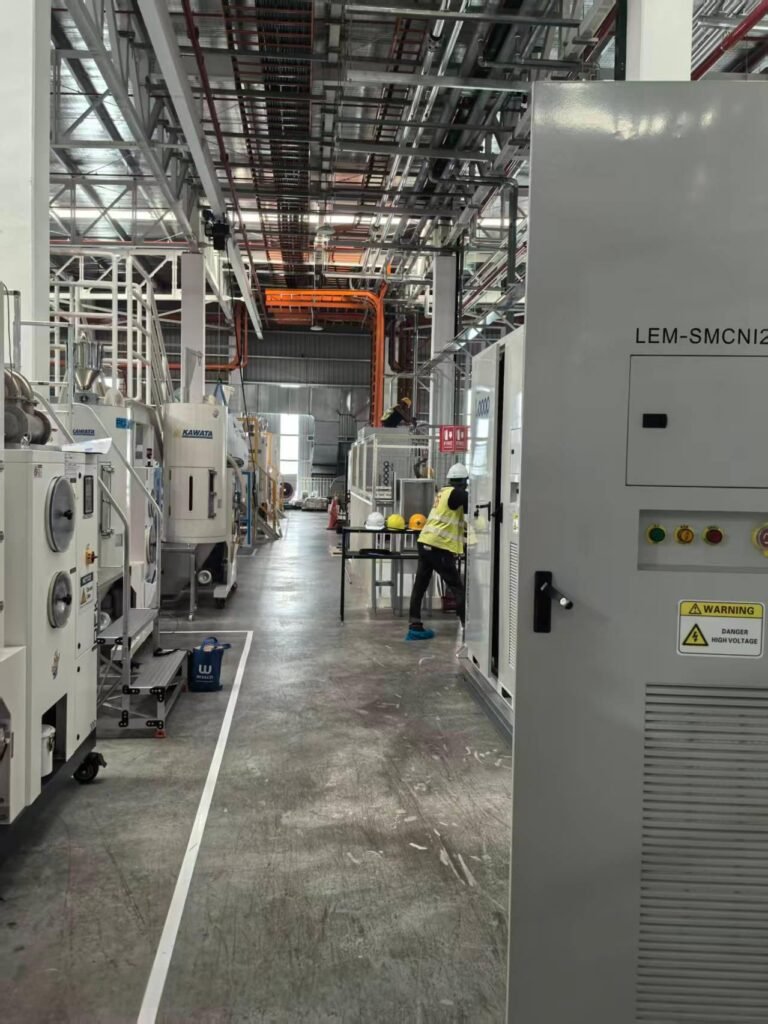
A BESS is controlled by several layers. The battery management system protects cells and reports limits. The power conversion system controls AC/DC power flow. The energy management system converts commercial and operating objectives into dispatch commands.
Problems appear when the boundary between those layers is undefined. A buyer may receive compatible hardware but no agreed owner for alarms, setpoints, time synchronisation or recovery after communication loss.
For a concrete equipment-level review, apply the checks above to the commercial and industrial energy storage range and request confirmation for the intended site conditions and operating mode.
Direct answer: Write an interface-control document before FAT. It should name every exchanged signal, update rate, unit, scaling, source of truth, fallback state and alarm owner.
Research review date: 30 September 2026. Quantitative statements are tied to the linked source and should be rechecked if procurement occurs later.
For specification and acceptance work, U.S. DOE BESS procurement checklist provides an independent reference. The U.S. Department of Energy checklist separates early project development, technical specifications and interconnection work for commercial lithium-ion systems.
The selection test
For System integrators, EPC engineers and technical buyers, the first task is to turn the intended service into measurable inputs and acceptance limits. The following table keeps the decision tied to evidence instead of a broad product label.
| Layer | Primary role | Typical buyer concern |
|---|---|---|
| BMS | Cell and rack monitoring, protection and charge/discharge limits | Accurate limits and fault hierarchy |
| PCS | Bidirectional power conversion and grid functions | Power quality, protection and derating |
| EMS | Scheduling, optimisation and site coordination | Dispatch logic and data integration |
| SCADA or portal | Supervision, history and remote access | Data ownership and cybersecurity |
| Metering | Revenue or control measurements | Accuracy class and point of measurement |
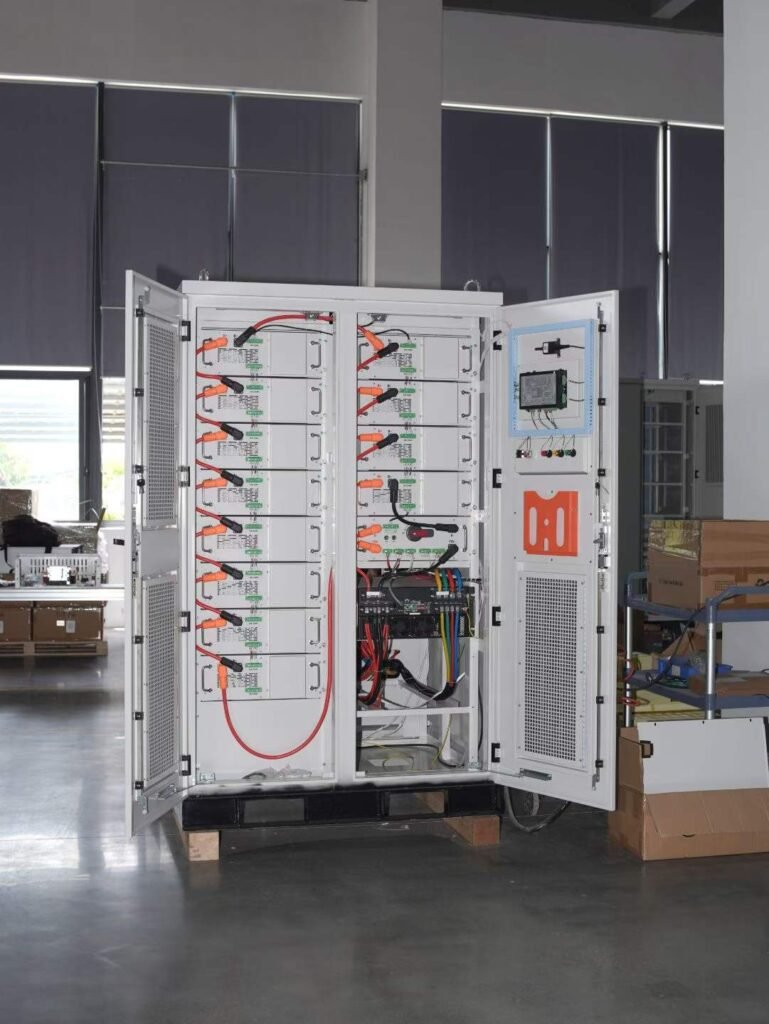
The same evidence and acceptance questions can be used when assessing HMX’s 100kW/215kWh air-cooled system; catalogue information should be reconciled with the controlled quotation and drawings.
Before design freeze, the project team should review IEC 62619:2022 scope. IEC 62619:2022 covers safety requirements and tests for secondary lithium cells and batteries used in industrial applications, including stationary and motive uses.
Control gaps that create commissioning delays
These are the practical objections and failure modes most likely to stop approval, delay commissioning or create an avoidable service call for System integrators, EPC engineers and technical buyers.
- No party owns the signal list, alarm mapping or time synchronisation.
- Firmware and protocol versions change after compatibility testing.
- Loss of cloud or site communications has no agreed fallback state.
Questions the buyer should ask before approval
- Which controller is the source of truth for each limit and setpoint?
- What is the safe response to stale or missing data?
- Who may change settings, and where is the audit log stored?
Evidence to request
The commercial offer should state its assumptions, exclusions and measurement boundary. Buyers can then compare systems on the same basis and keep later design changes under document control.
| Interface test | Normal condition | Failure condition |
|---|---|---|
| Active-power command | PCS follows within agreed tolerance | Safe fallback on timeout |
| Charge/discharge limit | PCS respects BMS dynamic limit | No command beyond safe limit |
| State of charge | Consistent value across displays | Quality flag on invalid data |
| Time sync | Events share one timestamp base | Alarm when sync is lost |
| Remote access | Authorised session and logging | Lockout after failed authentication |
Action points for the project team
- Require a signal list and protocol map in editable format.
- Define who can change setpoints and how changes are logged.
- Test cable disconnection, stale data, reboot and loss of site internet.
- Keep safety protection local; do not depend on a cloud service for immediate protective action.
For the final evidence review, use IEC 63056:2020 scope as a source check. IEC 63056 adds safety requirements for secondary lithium cells and batteries used in electrical energy storage systems up to 1,500 V DC nominal.
Write the interface-control document as a contract deliverable
The signal list should identify the source, destination, unit, scale, update rate, valid range, quality flag, timeout and fallback for every operational value. Important items include charge and discharge limits, state of charge, rack availability, alarms, active and reactive power commands, breaker states and emergency stops. A screenshot of a monitoring page is not an interface definition.
A related HMX reference is the 125kW/261kWh liquid-cooled system. Use it to frame the next supplier discussion, then record project-specific deviations before ordering.
Assign alarm ownership by control layer. The BMS should protect the battery; the PCS should respect dynamic limits and grid protections; the EMS should schedule within those limits. The site controller or operator must know which layer latched a trip and which conditions permit reset. This avoids unsafe repeated resets and prevents multiple systems from issuing conflicting commands.
For current market and policy context, review IEA Electricity 2026 flexibility analysis. The IEA identifies batteries as a versatile source of short-term power-system flexibility, but the required duration depends on the service being delivered.
FAT should test stale data, out-of-range values, cable loss, controller restart, time-sync loss and restoration after faults. Record firmware, protocol and configuration versions with the results. At handover, provide editable signal lists, backups and access-control records so later updates can be reviewed against a known working baseline.
A practical decision sequence
- Freeze named hardware, firmware and protocol revisions for FAT.
- Verify every critical signal in normal operation and failure states.
- Confirm that immediate protection does not depend on cloud connectivity.
- Hand over backups, change-control rules and a fault-escalation matrix.
Records that should survive the purchase order
The project file should let a new engineer reconstruct what was bought, why it was selected and how compliance was demonstrated. Keep source data and approved revisions together; a collection of undated email attachments is not adequate configuration control.
Buyers defining the initial scope can compare these requirements with HMX’s HMX project references. The page is a product or project reference; final suitability still requires a written project specification.
- Approved single-line, layout, interface schedule and equipment data sheets.
- Guarantee schedule showing operating conditions, measurement points and exclusions.
- Certificate and report index matched to the ordered model and configuration.
- FAT, shipping, SAT, training, settings backups and open-item closure records.
The technical comparison should also be checked against Wartsila Service+ lifecycle scope. Wartsila publicly separates software support, planned maintenance, performance guarantees and extended warranty into different service levels. That structure is a useful procurement benchmark: buyers should price and contract each lifecycle responsibility instead of accepting a general promise of support.
Review this baseline whenever equipment, firmware, operating mode or site responsibility changes. The technical file, guarantees and acceptance method should describe the same configuration throughout the project.

Handover Standard
At handover, the owner should receive drawings, settings, backups, event definitions, user permissions, training records and a tested recovery procedure.