
A battery state-of-health test is only useful when the buyer and supplier agree what health means. A BMS percentage, a measured ampere-hour capacity, delivered AC energy and available power describe different things. Treating them as interchangeable can turn an ordinary acceptance discussion into a warranty dispute.
For an industrial storage buyer, the practical question is whether the supplied battery retains the specified capability under the agreed conditions. That requires a matched reference, a defined measurement boundary and a repeatable procedure. It also requires a way to handle incomplete data and measurement uncertainty without selecting whichever number benefits one side.
When specifying commercial and industrial batteries, agree the capacity assessment before delivery. The workflow below is an original procurement and service framework, not an accredited test method, an instruction to bypass protection or evidence that a particular HMX product has achieved a stated SOH.
Which purchasing question is the test supposed to answer?
Separate initial equipment acceptance from diagnosis of an operating problem and from a warranty-capacity assessment. The same battery might need different evidence for each purpose. A new-system acceptance test should compare the supplied configuration with the agreed delivered capability. A service investigation should first establish whether a change in duty, controls or conditions explains the shortfall.
A warranty assessment must follow the applicable contract and approved procedure. The buyer cannot assume that a convenient field test determines the contractual result, while the supplier should not introduce a different denominator after a claim has arisen. Request the method, conditions and decision rule when negotiating the purchase.
Define the tested object: cell, module, finished battery or complete storage system. A representative component result can be relevant evidence, but it does not automatically establish the delivered energy of the installed system. Keep the tested identity and the claim it supports together.
Also define what the test will not decide. Capacity measurement does not independently establish product safety, remaining service life or suitability for every duty. A battery that meets a capacity criterion may still need investigation for a protection, thermal or integration problem.
Agree the numerator and denominator before calculating SOH
For a capacity-based comparison, a useful agreed convention is capacity SOH equals measured discharge capacity divided by the agreed reference capacity, expressed as a percentage. This definition is not a claim that all manufacturers use the same denominator or that a BMS implements this measurement.
The reference might be a rated capacity under specified conditions or an approved baseline measurement. Choose it explicitly and retain its source. Do not compare today’s restricted operating window with yesterday’s full reference window without explaining the difference. Changing the denominator can change the percentage without changing the battery.
For an energy-based comparison, use an agreed energy reference at the same boundary and comparable conditions. Capacity in ampere-hours is not the same quantity as energy in watt-hours. Voltage changes through discharge, so a nominal voltage multiplied by measured ampere-hours is not automatically the measured discharge energy.
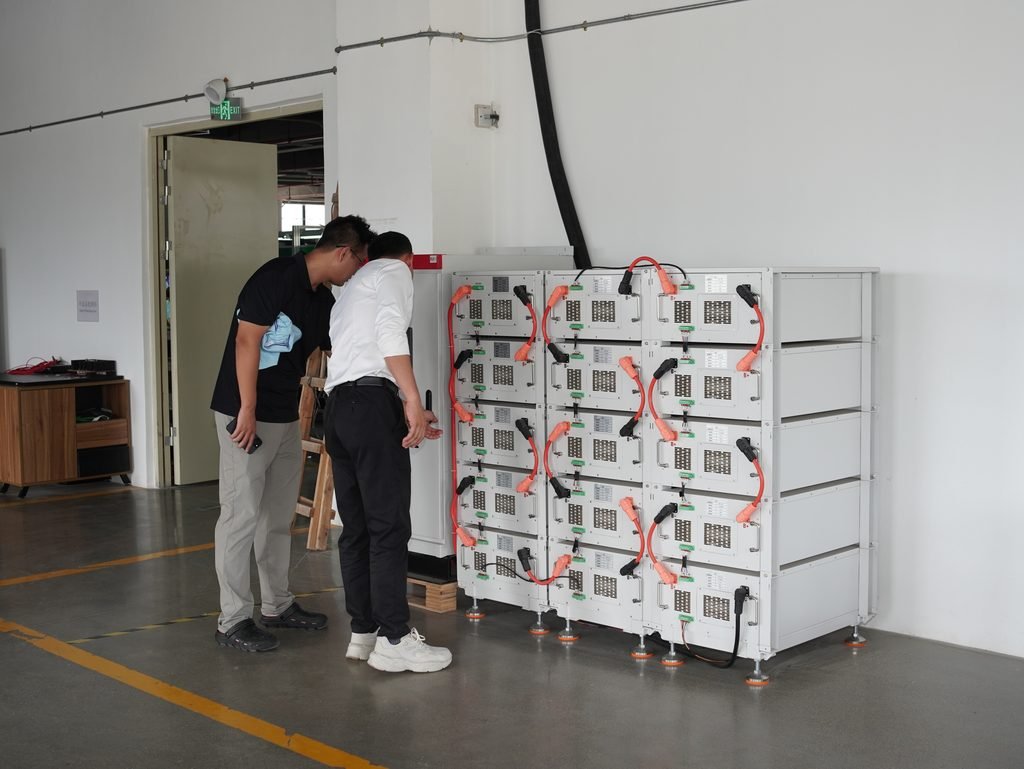
Use the liquid-cooled cabinet specification to identify the equipment being discussed, then request the actual ordered configuration’s rating basis. A product family name or catalogue energy headline is not a complete capacity-test agreement.
| Metric | Meaning in the agreed assessment | It does not establish by itself |
|---|---|---|
| Discharge capacity, Ah | Charge delivered between specified endpoints under stated conditions | Delivered AC energy or available peak power |
| Discharge energy, Wh or kWh | Energy delivered at the declared boundary during the test | A universal result at another current, temperature or endpoint |
| Capacity-based SOH, % | Measured capacity relative to the named reference | Remaining years of service or a warranty decision without the contract |
| BMS-reported SOH | An estimate defined by the manufacturer’s implementation | An independently witnessed capacity measurement |
| Resistance or power capability | A separately defined response or delivery characteristic | The same percentage retention as capacity |
Select the applicable standard without inventing its procedure
The official IEC catalogue for IEC 62620:2014+AMD1:2023 identifies tests and requirements for industrial secondary lithium cells and batteries, including stationary applications. The consolidated publication is edition 1.1, dated May 12, 2023. Its public catalogue scope does not disclose a complete acceptance procedure for the buyer’s project.
Ask a competent testing provider to identify the applicable standard, edition, test object and contractual procedure. If a standard is invoked, obtain and apply its actual relevant requirements through an authorized process. Do not reconstruct currents, temperatures, rest periods or pass thresholds from a catalogue description.
The IEC 62619 and IEC 63056 comparison addresses safety-related purchasing questions. Those considerations should remain separate from this capacity agreement. A safety document must not be presented as proof of a particular measured SOH or installed-system energy result.
Use the same discipline with independent laboratory reports. Check which model, unit, revision and method were tested. A report for another product or a smaller assembly needs an explained relationship to the supplied battery. A laboratory logo alone is not that explanation.
Put the measurement boundary in the test drawing
Show where current, voltage and energy are measured. At the battery DC terminals, the measurement characterizes the declared battery boundary. At the converter AC output, it includes the conversion path and any loads within that boundary. At a shared connection point, unrelated site loads can obscure the battery result.
Choose the boundary that matches the acceptance claim. A battery-capacity warranty might use a different boundary from an installed-system usable-energy commitment. Where both are important, specify separate results rather than relabel a convenient AC meter reading as cell capacity.
Identify auxiliary circuits and their supply paths. Cooling, controls and standby loads should be accounted for consistently. An auxiliary load counted in one test and excluded in another can create an apparent performance change that is actually a measurement-definition change.
Draw the permitted charging and discharge path, including any other source that can enter during the test. If PV, grid support or another battery contributes energy, the measurement must distinguish it or the test cannot support a battery-only claim. Keep the approved test arrangement with the results.
Control conditions without defeating normal protection

Specify the approved starting condition, charging procedure, stabilization requirement, discharge profile and endpoint. Use manufacturer instructions and the applicable test method to set the actual values. There is no defensible universal test current or temperature that can be inserted into every battery purchase.
Record ambient and available battery temperatures throughout the relevant stages, not only at the start. If a thermal limit changes the permitted power, preserve that event. A test completed at a reduced power level may still be informative, but it must be compared with an appropriate reference.
Keep firmware, protection settings and the supplied configuration fixed and recorded. A different current limit or discharge endpoint can change what the test measures. Do not silently change settings to produce a better capacity result, and never disable protection to reach an advertised rating.
Electrical setup and test operation must be handled by qualified personnel using suitable equipment, approved procedures and the site’s safety controls. Stop on the manufacturer’s required conditions. This article does not prescribe hazardous bench wiring, deliberate abuse or deep discharge beyond the approved limit.
If the test cannot reach the agreed endpoint safely, report that limitation and its cause. Do not replace the unmeasured portion with an optimistic capacity estimate unless the contract expressly accepts a validated estimation method. An incomplete test is not automatically a failed battery or a full capacity pass.
Make the capacity and energy calculations reproducible
Before calculating the total, check the logger’s current-direction convention against a known approved operating state. A reversed sign can turn charge into apparent discharge; a mixed sign convention can make a net counter look like a gross total. Record the convention in the readable report, not only in the calculation code.
Where several strings or cabinets contribute to the measured boundary, identify which were connected and permitted to operate. A disabled string can reduce the system’s delivered energy without demonstrating the health of each remaining battery. The test result should say whether it assesses the assembled system, an isolated unit or a subset of installed equipment.
Discharge capacity is obtained by accumulating current over time with the appropriate conversion to ampere-hours. Discharge energy is obtained by accumulating voltage multiplied by current over time with the appropriate conversion to watt-hours. Document the sign convention, sampling and treatment of charging or regeneration events.
Retain the raw time-series records and the calculation method. A final spreadsheet total without its source cannot show whether gaps, duplicate timestamps or a reset distorted the result. Record the integration interval and how missing samples are handled; do not quietly interpolate a substantial interruption into an apparently complete measurement.
Use instrumentation suited to the required range and accuracy. Retain instrument identity, calibration or verification evidence and relevant configuration. A meter’s resolution is not its measurement uncertainty, and displaying more decimal places does not create a more accurate result.
Check time alignment between measurement and system events. If the logger and BMS use different clocks, a protection event can appear before or after the actual change in current. Reconcile the timing enough to understand the stopping condition and preserve the original records.
Verify the energy accounting around any restart. A counter that clears on reconnection can lose part of the test; a cumulative counter can include operation before the test. Define the start and end readings explicitly and cross-check them against the event record.
Use field monitoring for context, not an automatic capacity certificate
The DOE FEMP evaluation-method overview, published January 30, 2024, describes approximate performance indicators from long-term metered charge and discharge data. Its examples include at least a year of hourly records. That monitoring purpose is different from a controlled capacity-acceptance test.
A storage system that rarely uses its full approved window may not demonstrate its full available capacity in normal operation. Likewise, a dispatch restriction can reduce energy delivered without proving irreversible capacity loss. Review the actual duty and control permissions before interpreting field throughput as an SOH result.
The BMS, PCS and EMS responsibilities guide helps identify where operating permissions and measurements originate. Preserve the first limiting event when service ends early. The displayed health estimate, discharge permission and connection-point energy may be reporting different parts of the same event.
Field records are still valuable. They can establish when a change began, whether operating conditions changed and which units behave differently under comparable duty. Use that evidence to select an appropriate approved test rather than demanding an intrusive capacity test for every unusual SOC display.
What the October 2026 research adds to a buyer’s evidence request
Robert Masse’s Public Battery Field Data preprint, revised October 7, 2026 reports a curated collection of 23 field-data releases from 17 research groups. It highlights differing formats, units, labels and completeness. It is a preprint, not a capacity-acceptance standard, peer-reviewed product qualification or test evidence for HMX batteries.
The purchasing implication proposed here is straightforward: require meaningful metadata with the values. Ask which battery generated the record, how the measurement was obtained, which units apply, what operating period it covers and which information is missing. A large dataset without those connections is weak evidence for an individual warranty decision.
Do not transfer an algorithm’s reported performance from unrelated batteries to the supplied system. Chemistry, equipment, duty and measurement conditions need an explained relationship. If a supplier proposes an estimation method instead of a direct test, require validation relevant to the intended application and a clear statement of its limits.
| Reference checked October 10, 2026 | Source detail | Appropriate use in procurement |
|---|---|---|
| IEC 62620 consolidated catalogue | Edition 1.1; May 12, 2023 | Identify industrial battery test scope; obtain the actual applicable procedure |
| DOE FEMP method overview | January 30, 2024; long-term metered-data assessment | Distinguish monitoring indicators from controlled acceptance |
| Public Battery Field Data | arXiv v2, October 7, 2026; 23 releases, 17 research groups | Understand metadata and comparability issues; not a product SOH guarantee |
Agree uncertainty and the decision rule before a borderline result
Check whether repeated results show a changing test condition before treating their spread as instrument error. Incomplete stabilization, altered starting state or a different discharge profile can move the result systematically. Document the condition change and decide whether the repeats are actually comparable. More repetitions cannot make an inconsistent procedure a sound reference.
Distinguish reporting precision from commercial certainty. Rounding a value near a limit can alter its apparent category, so retain the calculation precision needed by the approved rule while presenting a sensible readable result. State the rule used. Neither buyer nor supplier should choose a convenient rounding direction after learning which party would benefit.
Ask the test provider to identify the consequential sources of uncertainty. These can include measurement accuracy, time alignment, starting condition, temperature control and endpoint repeatability. Do not assign a generic uncertainty percentage without a defensible method and relevant equipment information.
Separate uncertainty from an acceptance tolerance. One describes confidence in a measurement; the other belongs to the agreed requirement and decision rule. The buyer and supplier should know how a result close to the limit is handled before seeing the result.
Define the retest process. Identify when an interrupted run is invalid, when changed conditions require a new comparison and who approves repetition. Do not discard a lower result merely because a later run is higher. Preserve both and explain their relationship.
For a disputed or material acceptance decision, consider a competent independent witness or testing provider. UL Solutions describes capacity and cycling among its ESS performance-testing services. This illustrates a type of independent assessment, not a statement that HMX has such certification or that this article constitutes its procedure.
| Observed case | Decision basis | Required next action |
|---|---|---|
| Valid matched test with clear result | Agreed reference, conditions and decision rule | Document the supported acceptance outcome |
| Result close to the contractual limit | Declared uncertainty and pre-agreed treatment | Apply the rule or approved retest; do not invent a margin |
| Test ends on an unexpected protection event | First limiting event and approved operating conditions | Investigate whether the run supports the intended capacity claim |
| Different boundary, firmware or reference used | Comparison is not matched | Correct the protocol or agree a justified alternative |
| Only a BMS screenshot or routine throughput is supplied | Direct acceptance evidence may be incomplete | Request the agreed measurement or validated estimation evidence |
Preserve the evidence needed for service and warranty
Retain the investigation sequence when poor site performance initiated the test. Record the reported symptom, the operating duty, the first alarms and the reasons the chosen capacity assessment addresses that symptom. If the capacity result is acceptable but the service problem remains, return to the relevant power, control or integration evidence. Do not close a customer complaint simply because one different metric passed.
Agree how sensitive operating records are shared with an independent assessor. Provide the necessary identity, conditions and measurement evidence through an authorized channel, while limiting unrelated commercial information. Exportability matters: a supplier-only dashboard should not be the sole way to interpret a result that the owner may later need to review with another qualified service team.

The final report should identify the battery, configuration, reference, method, conditions, instruments, raw records, calculations, uncertainty treatment and outcome. Include any limitations and unresolved discrepancies. Separate observed results from conclusions that depend on an estimate or an untested assumption.
Keep the report with the owner’s service file and the purchase documents. When reviewing the commercial BESS procurement requirements, add the agreed capacity-test deliverable, responsible parties and retest mechanism. A warranty promise is easier to administer when its measurement basis is settled before the equipment is supplied.
After a relevant component or configuration change, review whether the original baseline remains suitable. Preserve historical records rather than rewriting them to match the latest settings. The owner needs to understand both what was originally accepted and what now exists on site.
Questions buyers ask about battery SOH tests
Can the BMS SOH reading be used as the acceptance result?
Only if the contract accepts that defined method and the supplier provides the relevant implementation and validation evidence. A displayed percentage is an estimate until its meaning and relationship to the agreed capability are established. Do not assume it equals a witnessed discharge-capacity result.
Does a high capacity-based SOH guarantee full power?
No. Capacity and power capability are separate assessment questions. Voltage response, protection permissions, thermal conditions and the supplied integration can constrain power even when a capacity comparison is favourable. Request the required power evidence independently.
Must every test discharge to the battery’s protective cutoff?
No. The approved method defines the endpoints, and protection must remain active. The test should not deliberately exceed permitted limits. If the required measurement cannot be completed safely under the agreed arrangement, report the limitation and obtain a qualified approved approach.
Can ordinary charging history predict the remaining warranty life?
Not by itself. Operating history can support an assessment, but a remaining-life prediction requires a justified model, relevant conditions and disclosed uncertainty. A capacity measurement describes capability at its test conditions; it does not automatically predict a failure date.
What is the most important item to agree before ordering?
The relationship between the promised capability and its acceptance evidence: the tested object, reference, boundary, conditions and decision rule. Once those are clear, a capacity test can support an informed decision. Without them, even an apparently precise SOH percentage can leave the buyer’s actual question unanswered.