
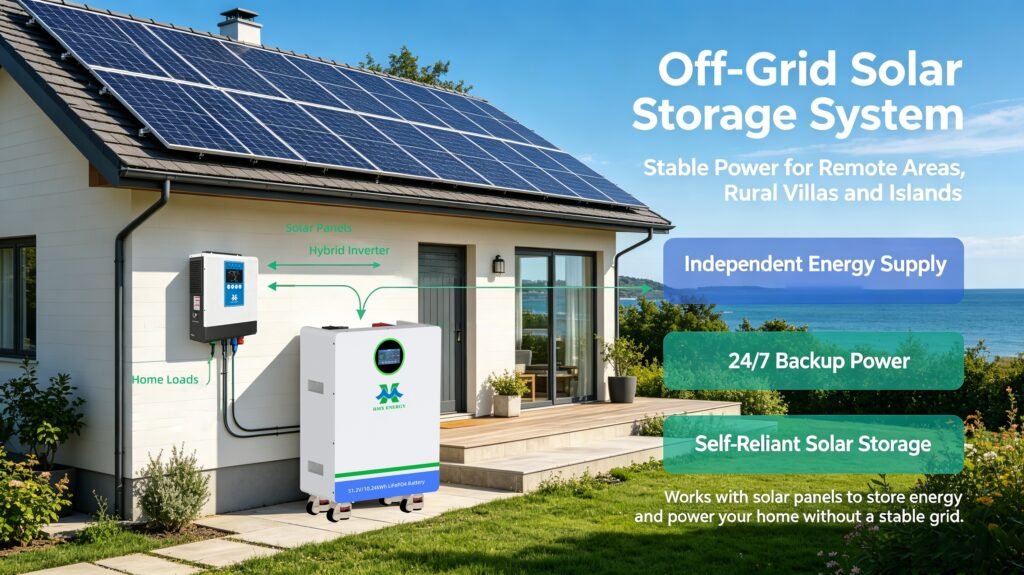
A homeowner wants the battery to reduce electricity purchases every evening and still be ready for an unexpected outage. Those objectives compete for the same stored energy. An installer who maximises daily discharge without discussing backup reserve may meet the first objective and disappoint the customer on the second.
A home battery backup reserve is an operating policy, not a universal percentage. Set it from the essential loads, expected refill opportunities, acceptable interruption risk and the delivered system’s capabilities. Explain what happens before an outage, during island operation and after the grid returns.
Define what “reserve” means on the proposed controller
Some systems reserve energy from normal grid-connected use and release it for outage supply. Other settings define a discharge floor that remains active in a particular mode. The names may look similar in an app while producing different behaviour. Obtain the model’s operating description rather than interpreting a slider by its label.
Tesla’s Backup Reserve support page describes how Powerwall allocates stored energy between routine operation and backup, including its outage and recovery behaviour. That is a manufacturer-specific example, not proof of an equivalent function or identical settings in an HMX system.
For the HMX home battery range, ask the supplier and installer to identify which controller implements the reserve, where its SOC value comes from and which modes the setting affects. The battery capacity and the inverter’s backup function must both support the intended service.
Begin with the loads the customer actually needs
Separate essential circuits from discretionary consumption. Refrigeration, lighting and communications may be priorities; vehicle charging or electric water heating may be deferrable. The decision belongs to the customer, supported by the installer’s load assessment. Do not assume that every household has the same essential demand.
Check energy and power separately. A reserve may contain enough energy for an intended period but still be unable to start or sustain a particular load. The inverter’s surge capability, battery limits and backed-up circuit arrangement remain relevant. Medical or other safety-critical loads need their own appropriate continuity assessment; a general home battery promise is not sufficient.
| Question | Evidence to collect | Policy implication |
|---|---|---|
| Which circuits are essential? | Customer-approved load list and circuit arrangement | Defines the backup service, not whole-house assumptions |
| When would an outage be most disruptive? | Occupancy, working patterns and local outage history | Identifies periods requiring greater readiness |
| What can be postponed during an outage? | Agreed discretionary loads and operating instructions | Provides a load-reduction plan |
| How can the battery refill? | Solar profile, approved grid charging and other sources | Tests whether the reserve can be restored |
| What interruption can the customer accept? | Load-specific continuity requirements | May require a separate solution for critical equipment |
Test the refill window before reducing the reserve
A low reserve can look attractive after a sunny day and become unsuitable after poor weather or a high evening load. Review when charging can occur and which constraints apply. If grid charging is restricted, a setting change cannot create a refill opportunity that the installation does not have.
The SAM behind-the-meter dispatch documentation treats charging sources, dispatch objectives and SOC constraints as separate inputs. Use that distinction when comparing policies. SAM’s defaults and simulation choices are not recommended settings for every battery, and they do not establish the functions of a particular inverter.
Request an analysis that uses the customer’s measured load, relevant solar data and actual tariff terms. Compare reserve policies without assuming that all available energy earns the same saving. Retaining energy for backup may forgo some routine discharge, but the economic result depends on the site’s import and export prices and recharge conditions.
For a residential all-in-one storage proposal, make those assumptions visible in the quotation. A claimed savings figure should state the policy under which it was calculated. Do not show a maximum-savings scenario and then configure a different backup priority at handover.
Weather preparation needs a defined trigger and authority
Tesla’s Storm Watch documentation describes a product-specific weather preparation function with prerequisites and regional availability. It illustrates why “weather-aware backup” needs more detail than a marketing phrase. Do not assume that an HMX installation receives those alerts or follows that control logic.
If a project uses forecast-driven or manually raised reserves, specify who initiates the change, whether grid charging is permitted and how the normal policy resumes. Provide a fallback when the forecast service or internet connection is unavailable. The customer should also have an approved method to prepare for a notified utility outage.
| Policy | Potential benefit | Limitation to explain |
|---|---|---|
| Consistently higher reserve | More energy retained for an unexpected interruption | Less energy available for routine discharge |
| Consistently lower reserve | More routine use of stored energy | Less starting energy if an outage occurs before refill |
| Time-dependent reserve | Can align readiness with customer needs | Depends on implemented controls and realistic recharge |
| Event-preparation reserve | Can increase readiness before a known risk | Not every outage is forecast or notified |
Evaluate outages at different starting conditions
The SAM grid-outage modelling documentation provides a way to examine backup performance. A model can support comparison, but its assumptions must reflect the delivered architecture and load coverage. A favourable simulated result is not a witnessed acceptance test.
Compare relevant outage starting points, not only a fully charged battery at noon. Include the periods after normal discharge and when replenishment is constrained. Report any unsupported loads, power restrictions and uncertainty in the inputs. Avoid a single runtime promise without the conditions that make it meaningful.
Use our off-grid battery sizing discussion to distinguish energy demand, reserve and replenishment. Even a grid-connected customer’s outage requirement benefits from that separation.
Give the customer an operating agreement
At handover, record the selected reserve policy, backed-up circuits, load-reduction instructions, preparation method and recovery behaviour. Explain that protective limits still apply and that a reserve setting does not guarantee every appliance or every outage duration.
The best policy is one the customer understands and the installed system can execute. Verify it, record the assumptions and revisit it when household loads, tariff terms or operating priorities change. That is more defensible than choosing a popular percentage and calling it optimal.