
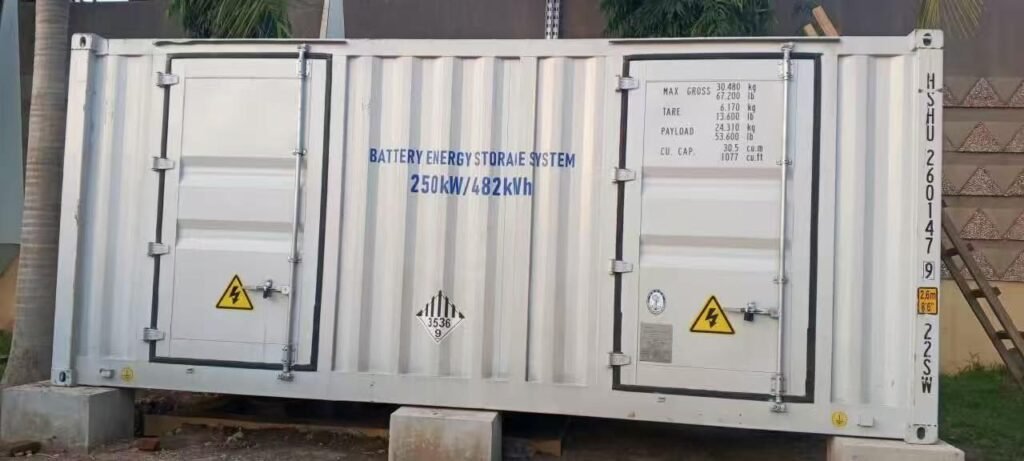
Backup power and black start are not the same promise. Backup may rely on a live control supply or another grid-forming source. Black start means the system can establish an energised bus from a de-energised condition and bring loads or generation online in a controlled sequence.
A tender should state the required starting condition, critical loads, transfer time and restart sequence.
For a concrete equipment-level review, apply the checks above to the Mali 100kW/215kWh off-grid project and request confirmation for the intended site conditions and operating mode.
Nameplate power and energy do not establish restart capability. The 100 kW / 215 kWh BESS application guide explains the usable-energy and operating-boundary checks that should accompany the state-sequence tests in this article.
Direct answer: Create a state diagram for grid loss, island formation, low battery, generator start, PV restart and grid return. Test the sequence with named loads instead of a general statement that backup is supported.
Research review date: 30 September 2026. Quantitative statements are tied to the linked source and should be rechecked if procurement occurs later.
The technical comparison should also be checked against IEA Electricity 2026 flexibility analysis. The IEA identifies batteries as a versatile source of short-term power-system flexibility, but the required duration depends on the service being delivered.
Define the de-energized starting condition
For Factories, mini-grids and critical-load facilities, the first task is to turn the intended service into measurable inputs and acceptance limits. The following table keeps the decision tied to evidence instead of a broad product label.
| Requirement | Question | Verification |
|---|---|---|
| Control power | What powers BMS, PCS, EMS and switchgear when the grid is absent? | Cold-start test |
| Grid forming | Which device sets voltage and frequency? | Islanded load test |
| Load pickup | What is the allowed step and motor-start capability? | Staged load test |
| Energy reserve | How much state of charge is protected? | EMS setpoint and alarm test |
| Grid return | How are synchronisation and transfer handled? | Return-to-grid test |
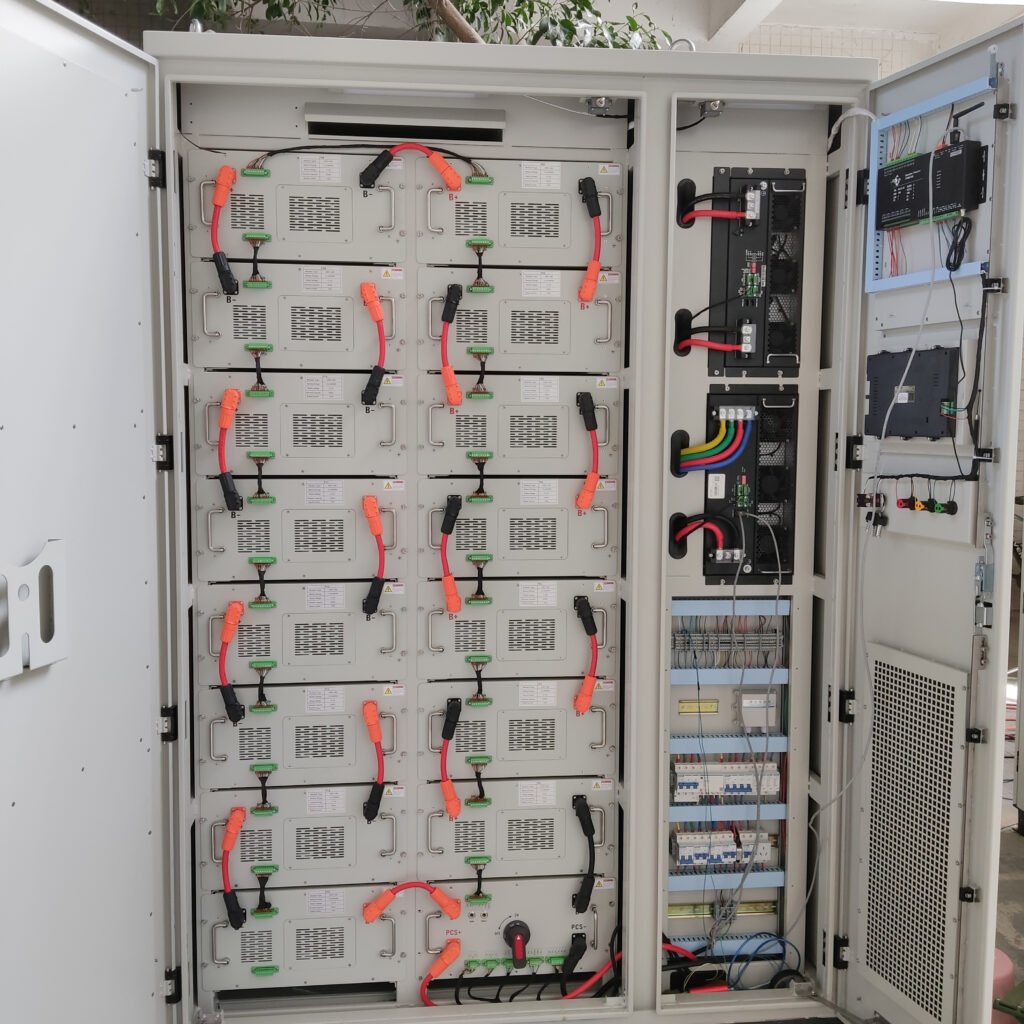
The same evidence and acceptance questions can be used when assessing HMX’s 100kW/215kWh air-cooled system; catalogue information should be reconciled with the controlled quotation and drawings.
For specification and acceptance work, U.S. DOE BESS procurement checklist provides an independent reference. The U.S. Department of Energy checklist separates early project development, technical specifications and interconnection work for commercial lithium-ion systems.
Write the energization sequence and load priorities
The commercial offer should state its assumptions, exclusions and measurement boundary. Buyers can then compare systems on the same basis and keep later design changes under document control.
| Load tier | Examples | Control treatment |
|---|---|---|
| Tier 1 | Protection, controls, emergency lighting | Always retained |
| Tier 2 | Refrigeration, IT, selected process loads | Started in sequence |
| Tier 3 | Large HVAC or noncritical production | Shed unless capacity allows |
| Flexible generation | PV or generator | Restarted under stable bus conditions |
| Maintenance load | Heaters, pumps and auxiliaries | Included in energy budget |
Action points for the project team
- Measure motor starts and transformer inrush where they matter.
- Include cold-weather or high-temperature derating in the black-start study.
- Test a low-state-of-charge event and failed generator start.
- Document manual recovery if automation cannot complete the sequence.
Before design freeze, the project team should review IEC 63056:2020 scope. IEC 63056 adds safety requirements for secondary lithium cells and batteries used in electrical energy storage systems up to 1,500 V DC nominal.
Why backup claims fail during a real outage
These are the practical objections and failure modes most likely to stop approval, delay commissioning or create an avoidable service call for Factories, mini-grids and critical-load facilities.
- Controls and switchgear have no power when the grid is already dead.
- Motor or transformer inrush exceeds the islanded source capability.
- PV or generator restart is not sequenced behind a stable bus.
Questions the buyer should ask before approval
- Which device establishes voltage and frequency from a dead bus?
- How much state of charge is protected for the event?
- Which critical loads start first, and which are shed?
Write and test the restart sequence state by state
Begin with a genuinely de-energised condition. Identify how the BMS, PCS, EMS, communications and switchgear obtain control power and how long that supply remains available. Name the device that establishes voltage and frequency, the permissives required before closing breakers and the response when one permissive is missing.
A related HMX reference is the commercial and industrial energy storage range. Use it to frame the next supplier discussion, then record project-specific deviations before ordering.
Build a load-pickup sequence from measured critical loads. Transformer energisation, motors, pumps and compressors may create short demands well above steady power. Define the maximum step, acceptable voltage and frequency excursion, delay between groups and loads that remain blocked. PV or generator connection should occur only after the islanded bus is stable.
For the final evidence review, use UL Solutions overview of UL 9540A as a source check. UL 9540A is a test method for evaluating thermal-runaway fire propagation in battery energy storage systems; it is not a substitute for a complete system listing or local installation approval.
Test low state of charge, failed generator start, communication loss and return of the utility. Record transfer times and any interruption seen by critical loads. The operating procedure should explain automatic and manual recovery, including the point at which the system must preserve energy for protection and control rather than serving additional load.
Project workflow
- Document control power and dead-bus start permissives.
- Measure inrush and stage critical loads by priority.
- Coordinate PV, generator and utility reconnection.
- Test failed starts, low reserve and manual recovery.
Preserve the tested restart state diagram
Compatibility and safety depend on the equipment as installed, not only on a catalogue selection. Preserve model and firmware identifiers, wiring and protection drawings, physical clearances, settings and test conditions. Later service work should begin from this baseline and record every approved change.
Buyers defining the initial scope can compare these requirements with HMX’s HMX project references. The page is a product or project reference; final suitability still requires a written project specification.
- Named equipment, firmware, accessories, cables and communication settings.
- As-built electrical and physical drawings with isolation points identified.
- Commissioning results for normal operation, limits and selected failure states.
- Backups, photographs, change log and a technician recovery procedure.
After service or firmware work, compare the returned system with the approved baseline and repeat affected tests. This makes later troubleshooting faster and prevents an undocumented field change from invalidating a compatibility or safety conclusion.

Risk Control
Design safe fallback states for loss of grid, communication, cooling, sensors and auxiliary power. Test the most important states before handover.