

A battery may cover a factory’s largest isolated demand event and still miss a smaller event later that day. The first discharge changes the energy available for the second. If the site cannot recharge in between, a sizing calculation that treats each peak independently can promise a result the dispatch cannot deliver.
BESS multiple-peak dispatch therefore needs a chronological review. Follow battery energy, charge capability, site import and protected reserve through the actual sequence. The question is not only “How large is the biggest peak?” It is “What condition is the battery in when each relevant peak arrives?”
Define the target at the billing meter
Identify the tariff’s demand measurement and the meter that determines the bill. Establish whether the target is a site import ceiling, a time-dependent threshold or another contract-specific rule. Do not substitute the PCS power reading for the billing-meter requirement without explaining the boundary.
SAM’s electricity-rate documentation distinguishes demand and energy calculations and describes billing-demand inputs. Its model conventions must be checked against the actual local tariff; software defaults are not the customer’s electricity agreement.
The peak-shaving sizing guide establishes the basic power and energy requirements. The chronological review below addresses the extra constraint created when several events compete for the same stored energy.
Build an event ledger before choosing a capacity
Keep the actual interval-load trace as the underlying evidence, then use a concise event ledger to explain the difficult sequences to decision-makers. The ledger should not replace the time-series simulation. It makes the critical constraints visible rather than hiding them behind one annual savings value.
| Sequence element | Condition to carry forward | Question for the model |
|---|---|---|
| Before the first peak | Available battery energy and protected reserve | Is the starting condition plausible for the operating policy? |
| During the first peak | Discharge power and energy used | Can the source follow the target within its limits? |
| Between peaks | Available charging time and site headroom | How much energy can actually be restored? |
| At the next peak | Updated battery condition | Does the remaining energy support the next event? |
| After the final event | Readiness for the following period | Does recovery create a new demand or reserve shortfall? |
At every step, distinguish nominal storage from energy available for the selected service. Reserve policy, operating limits and measured condition can restrict the portion that may be dispatched. Do not spend the same reserve once for tariff savings and again for outage support in the financial model.
The recharge gap is a power constraint as well as a time constraint
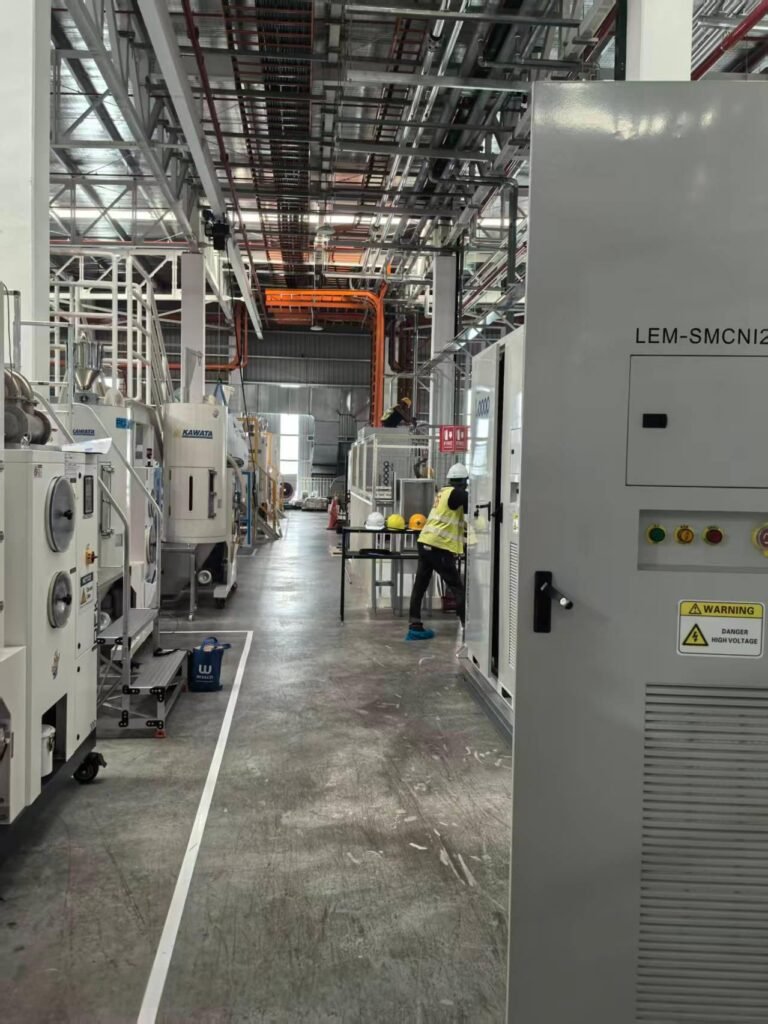
A long gap between peaks is useful only if charging is permitted and sufficient power is available. When factory demand remains near the import ceiling, charging at the battery’s maximum rating can defeat the purpose of peak shaving. The controller may need to reduce charging, leaving less restored energy than a capacity-only calculation assumes.
SAM’s behind-the-meter battery dispatch documentation describes charging and discharging against grid-power targets subject to battery capacity and SOC. This is a modelling framework, not a guarantee that a particular EMS implements the same algorithm.
Review recharge against transformer and connection headroom, allowed grid charging, solar availability, battery charge limits and tariff timing. A charger setting is not proof that the site can continuously supply that power. Also check whether auxiliary loads lie inside the constrained meter boundary.
For a cabinet-scale installation, use the configuration review in sizing a commercial BESS to identify the limits that belong in this chronological calculation. A system’s model name cannot establish the usable energy or recharge conditions of the project.
Test imperfect forecasts, not only a perfect replay
A retrospective simulation can know tomorrow’s demand because the entire historic trace is already present. A live controller has forecasts, current measurements and an operating policy. Ask whether the quoted result assumes perfect information, a day-ahead forecast or a fixed schedule, and how forecast error changes reserve allocation.
A sensible review includes unexpectedly early demand, a longer-than-usual production run and reduced recharge availability. These should use actual observed sequences where possible. Hypothetical cases must be clearly labelled and must not be represented as site measurements.
| Deliverable | Required detail | Reason for asking |
|---|---|---|
| Input trace | Source, timestamps, interval and cleaning record | Makes the starting evidence auditable |
| Battery state trace | Energy or SOC with defined reserve and limits | Shows whether capacity is reused impossibly |
| Site import trace | Charging and auxiliaries included as applicable | Reveals rebound demand |
| Dispatch assumptions | Forecast horizon, permitted charging and priority rules | Separates simulation knowledge from real control |
| Unserved target intervals | Magnitude, timing and reason for a missed target | Prevents an annual average from hiding critical failures |
Use actual load data for the buying decision
NLR’s REopt load-profile tutorial distinguishes generic simulated profiles from uploaded interval data. A reference profile can support early screening, but matching a monthly energy total does not establish the order or spacing of a particular factory’s demand events.
When comparing commercial and industrial storage systems, request both the predicted outcome and the difficult event sequence that limits it. If the target is infeasible, the response may be more energy, different charge scheduling, coordinated loads or a revised target; it should not be a silent change to the assumptions.
Decision rule for the investment review
A proposal is ready for commercial comparison when its discharge sequence and feasible recharge sequence fit together on one timeline, with reserve and equipment limits preserved. Retain the baseline file, model version and operating policy so that the result can be reproduced after commissioning.
The largest peak is only the beginning of the question. The useful capacity is the capacity that remains available when the next economically important event arrives.